
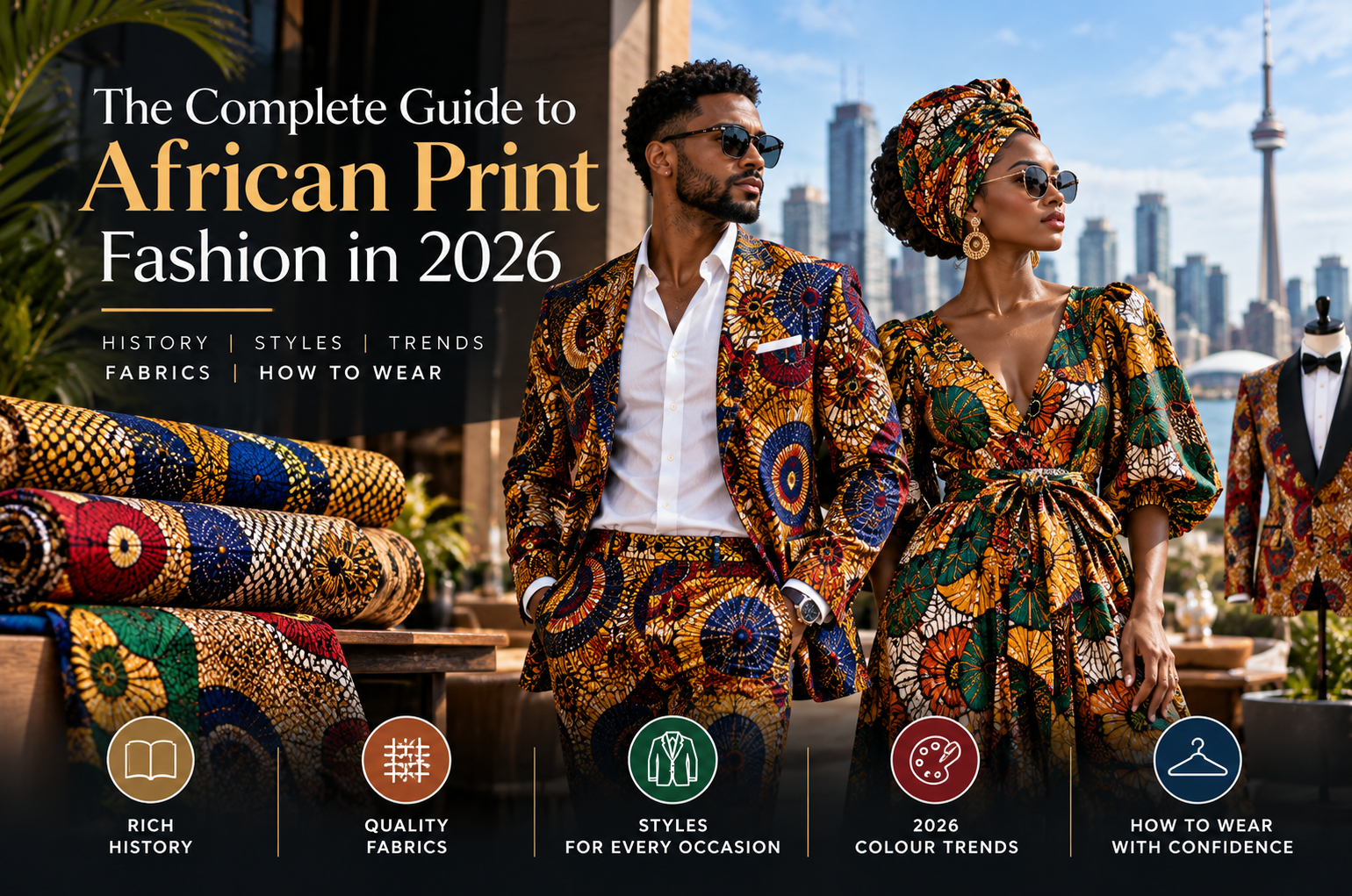
The Complete Guide to African Print Fashion in 2026
Few fabrics carry as much visual energy, cultural weight, and genuine versatility as African print. What used to live mainly at cultural events and family celebrations has moved firmly into everyday wardrobes, boardrooms, and red carpets alike. African print fashion 2026 is shaping up to be less about treating the fabric as a once-a-year statement piece and more about building it into a wardrobe people actually wear on repeat.
This guide covers everything worth knowing before you buy or build your next piece: where the fabric comes from, how to spot real quality, which styles are defining the look this year, and how to wear it with confidence in almost any setting.
A Short History of African Print Fabric
African print fabric, often called wax print, has a layered history that blends West African design traditions with a textile trade that stretched across continents. The wax-resist printing technique has roots connected to Indonesian batik, which was adapted and industrialized in the Netherlands during the colonial era and then exported to West African markets, where it was embraced, reinterpreted, and made entirely its own.
Over generations, West African designers, traders, and tailors shaped the fabric into something distinctly local, with patterns, colour combinations, and naming traditions that carry real cultural meaning within communities across Nigeria, Ghana, and beyond. Understanding this background matters, because it is part of why African print carries more weight than a simple fashion trend; it is a textile with a genuine story behind it.
African Print vs Ankara: Clarifying the Terms
These two terms get used almost interchangeably, which causes some confusion for newcomers to the style.
Ankara specifically refers to the wax print fabric as it is known and sold across much of West Africa, particularly Nigeria, where the name has become the common term for this style of printed cotton. African print is the broader umbrella term, covering Ankara alongside other regional printed textile traditions across the continent.
In everyday shopping and styling conversations, the two terms are often used to mean the same thing, and that overlap is generally fine. What matters more than the exact terminology is understanding that this is a wax-printed cotton fabric with a specific production method, distinct from a generic floral or geometric print manufactured without that same process or history.
Why African Print Fashion Is Having a Moment in 2026
A few forces are converging to push African print further into mainstream fashion this year.
Diaspora communities across Canada, the US, and Europe are increasingly choosing to wear pieces that connect to their heritage in everyday settings, not only at cultural events. At the same time, the broader fashion world has shown growing interest in bold pattern and colour after years of minimalist, muted wardrobes dominating mainstream trends. African print sits naturally at that intersection: it is visually distinctive, rooted in genuine cultural tradition, and increasingly available through custom and made-to-measure channels rather than only at specialty markets.
The result is a style that feels less like a costume reserved for specific days and more like a genuine wardrobe category, worn to the office, to weddings, and to everyday social occasions depending on how the piece is cut and styled.
How to Spot Quality African Print Fabric
Not all printed cotton sold as African print is made the same way, and the difference shows up quickly in how the fabric wears over time.
- Check both sides of the fabric. Genuine wax print shows the pattern clearly on both the front and back, since the wax-resist dyeing process penetrates the fabric rather than sitting only on the surface. A print visible on only one side is typically a lower-cost roller-printed imitation.
- Feel the weight. Authentic wax print cotton has a noticeable weight and slight stiffness when new, which softens with wear and washing over time.
- Look closely at the pattern edges. Genuine wax-resist printing often shows subtle texture or slight irregularity at pattern edges, a natural result of the hand-finished dyeing process, rather than a perfectly uniform machine print.
- Ask about colourfastness. Quality African print fabric should hold its colour well through washing when cared for properly, rather than bleeding or fading noticeably after the first few washes.
The Key African Print Styles Defining 2026
A few directions stand out this year as particularly strong within African print fashion:
- Tailored Ankara blazers and suits, cut with the same structure as a traditional suit but built entirely from bold printed fabric, for formal and smart-casual settings alike.
- Kimono-style pieces, which pair African print’s bold visual presence with a relaxed, flowing silhouette suited to both casual wear and statement evening looks.
- Print-and-solid combinations, pairing an Ankara jacket, kimono, or dress with solid neutral pieces to let the pattern lead without overwhelming the whole outfit.
- Mixed-print styling, confidently combining two or more complementary African prints in a single outfit, a trend gaining traction among more experienced wearers of the style.
- Custom-fitted formal wear, including women’s dresses and men’s suits built specifically from African print fabric rather than treating it purely as accent fabric.
Colour and Pattern Trends Shaping 2026
Alongside the bold, traditional multicoloured wax prints that have always defined the style, a few specific directions are standing out this year. Earthy, muted colourways, think terracotta, olive, and warm browns layered with the traditional bold patterning, are appearing more frequently alongside the classic high-contrast brights. Monochrome and tonal African print, where a single pattern is printed in varying shades of one colour family, is also gaining popularity for people who want the texture and visual interest of the fabric without the full intensity of a multicoloured print. Both directions sit comfortably alongside the louder, more traditional colourways rather than replacing them, giving shoppers a wider range of entry points into the style depending on how bold they want to go.
Ankara Suits vs Traditional Suits
One of the most common questions people have when exploring African print fashion is how an Ankara suit compares to a traditional solid-coloured suit, and when each one makes more sense. In short, an Ankara suit brings bold colour and cultural expression well suited to celebrations, creative events, and smart-casual settings, while a traditional suit remains the safer choice for conservative corporate or formal ceremonial occasions. We cover this comparison in full detail, including a side-by-side breakdown and styling tips for each, in our dedicated guide on Ankara blazers versus traditional suits.
Styling African Print With Confidence
Wearing bold printed fabric well comes down to a handful of reliable habits: choosing one true statement piece rather than overwhelming an outfit with multiple competing patterns, keeping accessories relatively simple so the fabric itself stays the focus, and getting the fit properly tailored so the garment reads as intentional rather than oversized or shapeless. For a full breakdown of styling approaches, including how to mix fabrics and textures and how to adapt traditional silhouettes for modern settings, see our complete guide on how to style African print clothing for contemporary looks.
Caring for African Print Garments
Proper care keeps African print fabric looking sharp for years rather than fading after a handful of wears.
- Wash in cool water and turn the garment inside out to protect the printed surface and reduce colour loss over repeated washes.
- Avoid prolonged direct sunlight when drying, since UV exposure can fade bold colours faster than indoor or shaded drying.
- Iron on the reverse side, or use a pressing cloth, to protect the printed surface from direct heat damage.
- Store folded rather than on a hanger for heavier pieces like structured blazers, to avoid stretching the fabric at the shoulders over time.
Why Custom-Made Works Especially Well for African Print
Bold pattern is less forgiving than a plain fabric when a garment does not fit properly. A slightly oversized plain shirt can pass unnoticed, but an ill-fitted Ankara blazer or kimono draws attention to the fit problem precisely because the pattern itself is already drawing the eye. Pattern placement also matters in a way it simply does not for solid fabric, since a well-cut piece positions bold motifs deliberately across the chest, shoulders, and sleeves rather than leaving the placement to chance.
This is exactly where made-to-measure African print clothing earns its keep. Building a piece to your own measurements means the tailor controls exactly how the pattern falls across your body, rather than cutting from a fixed pattern that happened to land the print awkwardly. For custom African print clothing, this level of control over both fit and pattern placement is difficult to replicate with a standard off-the-rack size.
Getting Started With Your Own Piece
If you are ready to build your own African print piece rather than browsing ready-made options, a few starting points are worth exploring. Our current Ankara collection includes tailored blazers and suits such as the “Sun” Ankara suit and the “Green Honeycomb” Ankara suit, alongside African print kimono styles for a more relaxed silhouette. For a fully custom build, the suit builder lets you choose your own fabric, fit, and construction details from scratch.
Frequently Asked Questions
Is African print clothing appropriate for the workplace?
It depends on the cut and the workplace itself. A well-tailored Ankara blazer worn over a solid shirt and neutral trousers reads as smart casual to business casual in many modern offices, while a more relaxed, flowing piece suits creative or casual environments better than a conservative corporate setting.
What is the difference between Ankara and Kente?
They are both significant West African textile traditions, but they are produced differently. Ankara is a wax-printed cotton fabric, while Kente is a woven fabric traditionally associated with the Akan people of Ghana, made on a loom rather than printed. They are visually distinct and should not be used interchangeably.
Can African print be mixed with Western-style tailoring?
Yes, and this is actually one of the most popular approaches in 2026. A classic Western blazer or suit silhouette cut entirely from African print fabric, or paired with African print accent pieces, is a common and well-received way to blend the two traditions.
How do I choose which African print pattern suits me?
Start with scale and colour rather than overthinking the specific motif. Larger, bolder patterns tend to suit statement pieces like a blazer or kimono, while smaller, denser patterns work well for pieces you intend to pair with multiple other items in your wardrobe.
Is African print fashion only for formal or cultural events?
Not anymore. While it remains a strong choice for weddings and cultural celebrations, more people are incorporating African print into everyday smart-casual and even office wardrobes through well-tailored blazers, shirts, and accent pieces.
Do I need to match my African print piece to a specific cultural tradition to wear it respectfully?
Appreciating and wearing African print fashion thoughtfully generally means buying from makers who produce the fabric and garments properly, understanding the basic background covered earlier in this guide, and wearing the piece with genuine intention rather than treating it as a costume. Beyond that, the style has long been worn and adapted across a wide range of contexts, and a well-made, respectfully sourced piece is appropriate for most people to wear and enjoy.
Final Thoughts
African print fashion 2026 represents a genuine shift from occasional statement pieces to a wardrobe category people build around and wear regularly. Understanding the fabric’s background, knowing how to spot genuine quality, and getting the fit right through custom tailoring are the three things that separate a piece you wear once from one that becomes a real part of your rotation.
Ready to build your own African print piece? Explore Kavoo’s Ankara and African print collection to get started.