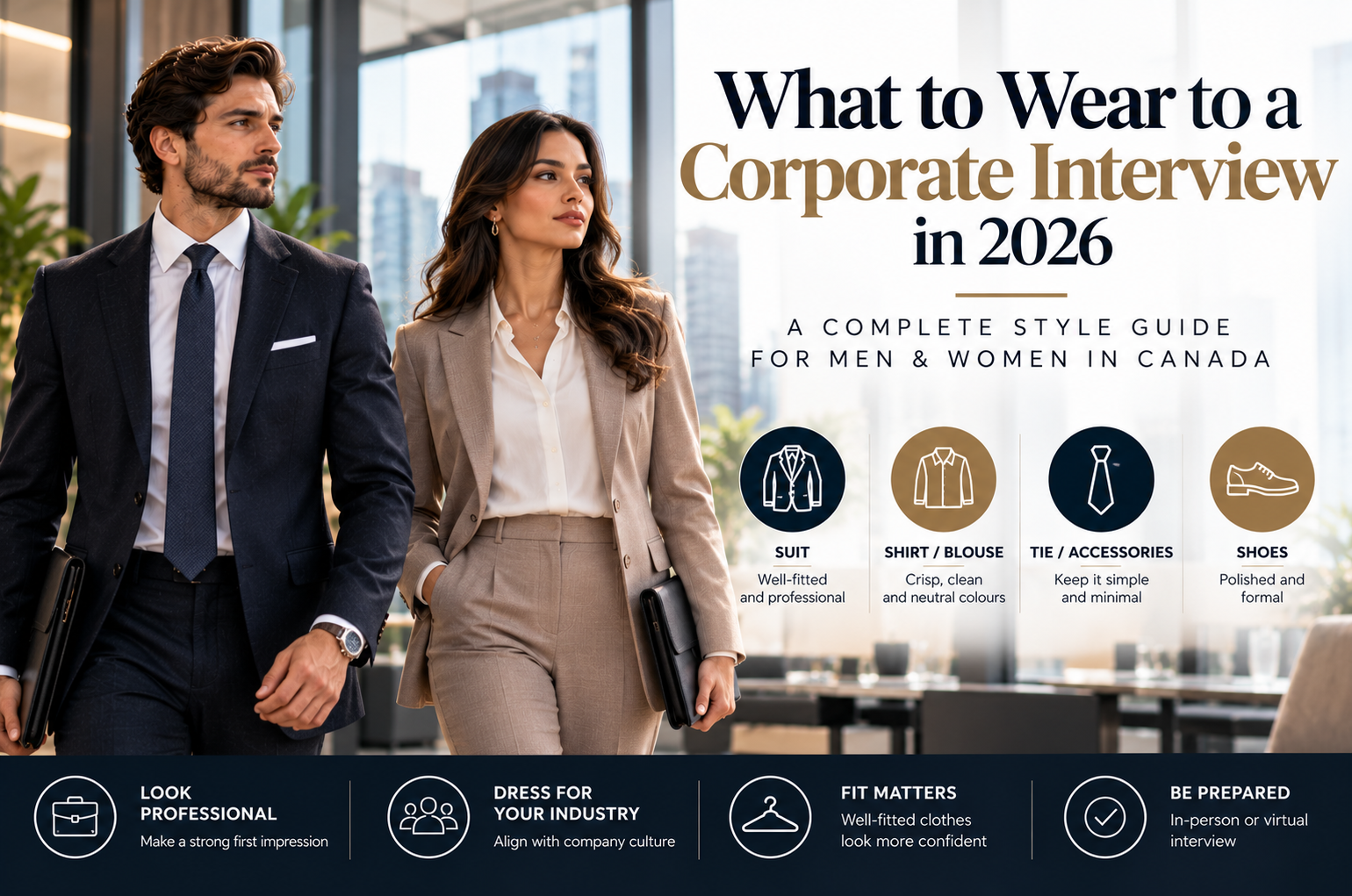
What to Wear to a Corporate Interview in 2026
An interview outfit does one specific job: it should help the interviewer focus entirely on what you are saying, rather than noticing what you are wearing at all. Get it right, and your clothing becomes invisible in the best possible way. Get it wrong, whether too casual, too flashy, or visibly ill-fitting, and it quietly competes for attention you need for the actual conversation.
Putting together the right interview outfit men women Canada candidates can both rely on comes down to a few consistent principles rather than a single fixed uniform. This guide walks through exactly what to wear, for men and women, across different industries and interview formats, so the outfit stops being a source of last-minute stress.
Start by Researching the Actual Dress Code
Before choosing anything, find out what the company’s everyday dress code actually looks like, since this should influence your interview outfit more than generic advice does. A few reliable ways to check:
- Look at employee photos on the company’s own website or LinkedIn posts.
- Check the company’s social media for casual behind-the-scenes photos of the team.
- Ask the recruiter directly what is appropriate; this is a completely normal question and rarely reflects poorly on a candidate.
As a general rule, it is safer to dress one level more formal than the daily office standard for a first interview, then match the everyday dress code more closely once you have the role.
Men’s Corporate Interview Outfit
A reliable men’s interview outfit for most corporate settings includes:
- A well-fitted suit in navy or charcoal, which reads as polished and professional without feeling overly severe.
- A crisp dress shirt in white or light blue, ironed and free of visible wrinkles.
- A conservative tie in a solid colour or simple pattern, avoiding anything overly bold or novelty-themed.
- Leather dress shoes in black or brown, polished and free of visible scuffs, matched to a leather belt in the same tone.
- Minimal accessories: a simple watch and, if worn, subtle cufflinks rather than anything attention-grabbing.
Fit matters more here than almost any other detail. A suit that gaps at the shoulders, bunches at the back, or has sleeves running past the wrist bone undercuts even an expensive fabric choice. For a deeper breakdown of how to build a complete, well-fitted wardrobe beyond just the interview suit, our men’s style guide covers the fundamentals in more depth.
Women’s Corporate Interview Outfit
A reliable women’s interview outfit follows the same underlying logic: tailored, polished, and free of distractions, with a bit more flexibility in the specific pieces.
- A tailored suit, either a matching blazer and trousers or a blazer with a knee-length pencil skirt, in a neutral colour such as navy, charcoal, or black.
- A blouse in a solid colour or subtle pattern, avoiding anything too casual or overly sheer for a formal interview setting.
- Closed-toe low heels or flats, in good condition, rather than casual sandals or very high heels that could feel impractical.
- A structured, solid-colour dress paired with a blazer is a strong one-piece alternative to separates, particularly for a first interview.
- Minimal jewellery and a simple handbag or portfolio case, keeping accessories supportive rather than the focal point of the outfit.
Choosing the Right Colours
Colour choice genuinely affects how an outfit reads in an interview setting, even if it operates mostly below conscious notice for the interviewer.
- Navy is widely considered one of the safest, most versatile interview colours, reading as professional and approachable without feeling cold.
- Charcoal and grey project seriousness and competence, making them strong choices for more conservative industries like finance or law.
- Black can read as slightly severe for some interview settings, so it tends to work best balanced with a lighter shirt or blouse underneath rather than worn head to toe.
- White and light blue remain the safest shirt and blouse colours, since they pair cleanly with almost any suit colour and photograph well on video calls.
- Save bold colours and bold patterns for after you have a sense of the company culture, rather than introducing them on a first interview.
Dressing for Different Industries
The exact formality expected varies meaningfully by industry, and calibrating to that is worth the extra thought.
- Finance, law, and consulting: lean toward the most traditional, conservative end of the spectrum, with a full matching suit the safest default.
- Corporate and government roles: a fairly traditional interpretation of business formal works well, similar to finance but with slightly more room for colour variation.
- Technology and creative industries: a full suit can occasionally read as overdressed, though a blazer with tailored trousers or a smart dress remains a safe, polished middle ground.
- Client-facing sales roles: lean formal, since first impressions with clients are directly tied to the role itself.
When genuinely unsure, overdressing slightly is almost always the safer choice than underdressing for a first interview.
Dressing for a Virtual Interview
Video interviews have become a standard part of the hiring process, and they come with a few dressing considerations that in-person interviews do not.
- Dress fully, not just from the waist up; sitting differently or needing to stand unexpectedly during the call is common, and a mismatched outfit can be an unwelcome surprise.
- Solid colours generally read better on camera than busy patterns, which can appear distracting or create a strange visual effect on lower-quality video connections.
- Avoid pure white directly under bright lighting, since it can occasionally overexpose on camera; a soft light blue often performs better on video specifically.
- Check how your outfit actually looks on camera beforehand, including lighting and background, rather than assuming it will translate the same way it looks in person.
Common Interview Outfit Mistakes
- Wearing something brand new without testing it first. A stiff, unworn shirt or new shoes that have not been broken in can cause visible discomfort during the interview itself.
- Over-accessorizing. Jewellery, ties, or accessories that draw the eye compete with the conversation rather than supporting it.
- Ignoring fit in favour of brand name. An expensive suit that fits poorly reads worse than an affordable one that is properly tailored.
- Underestimating grooming. Scuffed shoes, visible wrinkles, or an unkempt appearance can undercut an otherwise strong outfit faster than almost any clothing choice itself.
- Dressing for the job you have, not the one you are interviewing for. If you are interviewing for a more senior or client-facing role, it is worth dressing slightly above your current everyday standard.
Grooming and Finishing Touches
Clothing is only part of the overall impression, and a handful of grooming details often matter as much as the outfit itself.
- Shoes: polished and free of visible scuffs, since worn-looking footwear is one of the first things a trained eye notices, even on an otherwise sharp outfit.
- Hair and facial hair: neat and intentional rather than unkempt, whatever style you normally wear day to day.
- Nails: clean and trimmed, which is a small detail that nonetheless gets noticed during a handshake or when gesturing across a table.
- Fragrance: light or absent, since a strong scent in a small interview room can be distracting rather than impressive.
- Ironing: every visible garment, including the parts that might feel hidden under a jacket, should be properly pressed; a wrinkled shirt collar peeking out from under a blazer undercuts an otherwise sharp suit.
None of these details require much time to get right, but skipping them is one of the fastest ways to undercut an otherwise well-chosen outfit.
Building a Small Interview Wardrobe Rather Than a Single Outfit
Most job searches involve more than one interview, often across several companies and formats, so it is worth thinking slightly beyond a single outfit. A small, well-chosen rotation covers this far better than one expensive piece worn repeatedly.
- One versatile suit in navy or charcoal that works across most industries and formality levels.
- Two to three shirts or blouses in safe, complementary colours, so the same suit can be restyled slightly between rounds with the same company.
- One pair of well-maintained dress shoes, paired with a matching belt, rather than multiple lower-quality pairs.
- A couple of understated accessories, kept minimal and interchangeable rather than specific to a single outfit.
Building this rotation around pieces that are properly fitted means the same core wardrobe can be mixed and restyled across several interview rounds without ever looking repeated or underprepared.
Why a Properly Fitted Suit Matters So Much Here
An interview is one of the few situations where a slightly imperfect fit genuinely has stakes attached to it, since the interviewer is forming a fast, largely visual first impression before you have said a word. A suit built to your own measurements removes the common fit issues that come with standard sizing, shoulders that gap, sleeves that run long, or a jacket that pulls across the back, so the outfit reads as intentional rather than borrowed.
If you are building your interview suit from scratch, our suit builder and lady suit builder let you choose fit, fabric, and style details specific to your own measurements rather than settling for the closest available size.
Frequently Asked Questions
Is a full suit always necessary for a corporate interview?
Not always, but it remains the safest default for a first interview at most traditional corporate employers. For technology or creative roles, a blazer with tailored trousers or a polished dress can be equally appropriate, particularly once you have researched the company’s actual dress code.
What colour suit is safest for a first interview?
Navy and charcoal are generally considered the safest, most versatile choices, since both read as professional across a wide range of industries without feeling overly severe.
Should I match my outfit to the interviewer’s likely style or dress more formally regardless?
Dressing slightly more formally than the everyday office standard is generally the safer approach for a first interview, even if research suggests the workplace itself is more relaxed day to day.
How early should I plan my interview outfit?
Ideally a few days before the interview, giving enough time to have a garment altered if needed, test how it looks on camera for a virtual interview, or replace anything that does not fit as expected.
Does an interview outfit matter as much for a second or third round interview?
It still matters, though by later rounds you have usually gathered a clearer sense of the company’s actual dress code, so it is reasonable to dress slightly closer to the everyday standard rather than repeating the most formal option every round.
What if I cannot find out the company’s dress code before the interview?
When no information is available, defaulting to a well-fitted suit in navy or charcoal is the safest fallback, since it reads as appropriately formal across almost every industry. It is far easier to remove a tie or swap a jacket for a more relaxed look once you arrive and sense the room than to arrive underdressed with no way to adjust.
Reflexiones finales
A strong interview outfit men women Canada candidates wear across industries shares the same underlying principles: research the actual dress code, prioritize fit above all else, keep colours and accessories understated, and dress slightly more formal than the daily standard when in doubt. Get those fundamentals right, and the outfit does exactly what it should, fade into the background so the conversation gets all the attention.
Ready to build an interview outfit that actually fits? Explore Kavoo’s custom clothing collections to get started.